Isaak Levitan lived and worked at a period when Russian culture in all spheres was flourishing. His contemporaries were Repin and Surikov, Nesterov and Serov, Chekhov and Gorky, Chaliapin and Yermolova. In his short creative life Levitan produced about a thousand paintings, pastels and drawings.
He was born in the small Lithuanian town of Kibarty. His father worked as cashier at the railway station; the family was large and poor. In the hope of improving matters, the father took his family to Moscow, but his wife died suddenly and shortly thereafter he himself passed away.
When he was thirteen Levitan entered the Moscow School of Painting, Sculpture and Architecture. Though constuntly hungry and penniless, often without even a roof over his head, he studied diligently. In September 1876 he found himself in Savrasov's landscape class and later he became a pupil of Vasily Polenov.
Despite his success, the Council of the School declined to award him a silver medal, and the diploma he received merely entitled him to be a teacher of drawing. Levitan left the Moscow School. Later he would return there, a famous artist, and would run the landscape studio.
Among the earliest surviving works by Levitan are two small landscapes which were shown at student exhibitions—*Evening* (1877, TG) and *Sunny Day. Spring* (1877, private collection). And although they are not devoid of faults —a certain naivity, and an overabundance of details—these works are full of a bright youthful love of nature. At a student exhibition of 1880 Pavel Tretyakov acquired the nineteen-year-old artist's painting *Autumn Day at Sokolniki* (TG). This was the first recognition of his talent. The work attempts to recreate the mood people have on a dismal wet autumn day. Yet the attempt to work in a new manner, sweeping and generalized, was still in many ways studentish: the young artist still had to study nature more and master new painting devices.
In the summer months from 1880 to 1884 Levitan lived in Ostankino and painted a lot from nature, producing, among others, *Oak Grove in Autumn* (1880, Gorky State Art Museum), *Oak-Tree* (1880, TG) and *Pines* (1880, private collection). At Savvinskaya Settlement near Zvenigorod he painted the landscapes *Last Snow. Savvinskaya Settlement* (1884, TG) and *A Bridge at Savvinskaya Settlement* (1884, TG).
In 1885, at the Kiselev estate in Babkino, Levitan met the writer Anton Chekhov, with whom he remained friends for the rest of his life.
It was not until the mid-eighties that the painter's material circumstances improved. But his hungry childhood, hardships and intense work had already done damage to his health: his heart condition worsened considerably and he went to the Crimea to regain his strength. On his return he mounted an exhibition of sixty of his landscapes.
In 1887 Levitan at last realized his dream of visiting the Volga. The 'Volga period' in his work continued util 1890.
Levitan is one of the greatest poets of the Volga. The scenery of the Volga region, with its boundless expanses and its alternating forests, valleys, fields, large towns and tiny villages, inspired him with new artistic material. His Volga landscapes are quite varied... In *Evening on the Volga* (1888, TG) and *Evening, Golden Pool* (1889, TG), there is a sense of solemn silence and majestic tranquility. The picture *After Rain, Plyos* (1889,TG), on the other hand, has an altogether different emotional timbre. Here there is no peace: the wind chases the clouds and the water is disturbed... The bluish-silvery colours, with innumerable intermediate shades, give an impression of moving light and quivering air. Particularly noteworthy are the pictures *Golden Autumn in the Village* (1889, RM) and *Birch Grove* (1889, TG) in which Levitan conveys with great immediacy his perception of various states of nature. The artist's infatuation with nature is evident in all these works.
'I cannot be even vaguely happy, or at ease, I cannot understand myself, without painting. Never before have I loved nature as I do now, or been-so sensitive to it,' he wrote at this time to Chekhov.
In March 1891 Levitan became a member of the Society of Peredvizhniki. S. T. Morozov, a lover and patron of art, provided him with a studio.
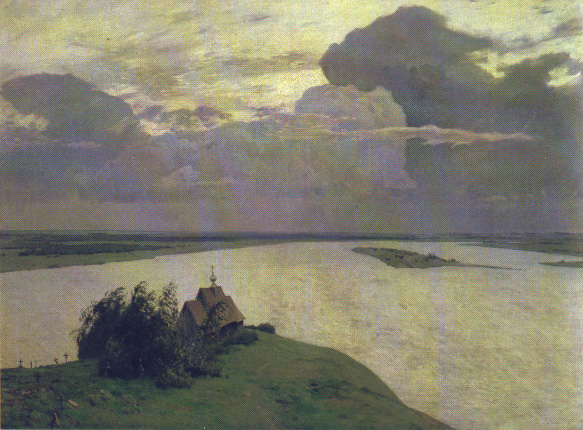
Levitan's work from 1890 to 1895 shows a desire to depict nature in an epic way: cf. *A Pond* (1892,TG), *Vladimirsky Highroad* (1892, TG), *Eternal Peace* (1894, TG). In Vladimirsky Highroad, one of Levitan's best works, he depicted a well-known highway, which was taken by exiles heading for Siberia. The highway stretches into the distant violet horizon; at a crossroads, where there is a rise in the soft undulating land, stands a wayside shelter in which the exiles could rest. The darkened copses arc silent, and the sweeping sky, the low horizon and the boundless plains create an impression of infinite space. In this painting we have an example of the enormous social message which a landscape painter can invest in his works. Levitan gave the painting to the Tretyakov Gallery as a gift.
The artist's constant search for new artistic forms found its expression in his picture *Eternal Peace*.
The vast Russian scenery forever attracted Levitan, which is seen both in his early paintings and in the majestic panoramas of his Volga cycle.
The year 1895 was a difficult one for Lcvitan. His heart disease was sapping his strength, and was accompanied by attacks of pain and asthma. These physical disorders and his state of melancholy sometimes brought Levitan to the brink of despair and attempts to commit suicide. But the life giving force of his love of nature and art was strong enough to overcome his illness and even to lead him to new creative discoveries.
Levitan's move in March 1894 to Tver Gubernia—to Ostrovno, and later to Gorki— ushered in the last period in his art.
In the sunny days of March nature comes to life (March, 1895, TG), streams rush and sing (*Spring. Last Snow*, 1895, RM) and apple-trees blossom fragrantly (*Apple-Trees in Blossom*, 1896, private collection); in the crystal clearness of autumn, leaves flash like gold, the rivers are blue and the groves empty (*Golden Autumn*, 1895, TG), and 'nature's splendid fading' begins (*Autumn*, 1895, private collection; *A Highway. A Sunny Day in Autumn*, 1897, private collection). The lyrical beauty of nature is presented as a glorious hymn to the artist's homeland.
The cycle of lyrical landscapes painted in 1895-96 is completed by the picture *Flooding in Spring* (1896-97, TG).
Levitan's last landscapes are remarkably delicate and profound, redeclaring the artist's desire to perfect his art so that one could 'hear the grass growing' in it. More and more he tried to catch nature's most elusive moments and sought to achieve extreme succinctness: cf. *The Last Rays of the Sun*, (1899, TG), *The Moon. Twilight* (1899, RM), and the artist's acknowledged masterpieces *Dusk* (1900, TG) and *Haysiacks at Dusk* (1899, TG).
Several marvellous water-colours and pastels also date from this time—for example *Mist in Autumn* (1899, RM) and *Meadow at the Edge of a Forest* (1898, RM).
In 1898 Levitan was awarded the title of an academician of landscape paintings. He taught at the Moscow School of Painting, Sculpture and Architecture, and his landscapes were exhibited at the All-Russia exhibitions as well as in Munich and Paris. But, just as he gained universal recognition and fame, his health took a sharp turn for the worse and his heart-disease steadily progressed. A course of treatment abroad helped for a short while.
'Levitan is dying, it seems,' wrote Chekhov... Still his 'terrible thirst for life' fought against his illness.
*The Lake* (1899-1900, RM) was the last picture he painted. Levitan considered calling the work Russia; it was to be a kind of synthesis of all his searchings. The Lake is a generalised image of the beautiful Russian countryside. Russia, the Motherland—such where the artist's last thoughts and feelings. He did not complete the picture, as he wanted to. On 22 July 1900, Levitan passed away.